

Product
Socket for Jira Is Now Available
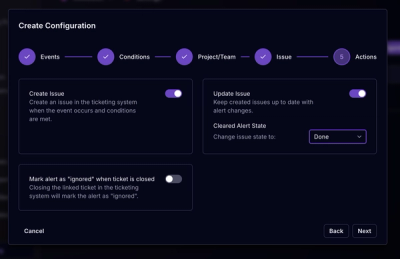
Socket for Jira lets teams turn alerts into Jira tickets with manual creation, automated ticketing rules, and two-way sync.
By Jeppe Hasseriis - Apr 20, 2026
@dfroehli42/infinispan
Advanced tools
infinispan is an asynchronous event-driven Infinispan client for Node.js.
The results of the asynchronous operations are represented using
Promise instances. Amongst many advantages,
promises make it easy to transform/chain multiple asynchronous invocations
and they improve error handling by making it easy to centralise it.
The client is under heavy development but here's a summary of its current capabilities:
infinispan client can be constructed with a single server address or
multiple servers addresses. When passing multiple addresses, it will iterate
until it finds a server to which it can connect to.{cacheName: 'myCache'} option. In the absence of any cache
name options, the client will interact with the default cache.put, get, remove, containsKey...etc.putIfAbsent,
getWithMetadata, replace, replaceWithVersion,
removeWithVersion..etc.{lifespan: '1m', maxIdle: '1d'}.{previous: true} option.putAll, getAll,
clear...etc.iterator method.size method.addListener method, which
takes the event type (create, modify, remove or expiry) and the
function callback as parameter.addScript and then they can be remotely
executed using the execute operation. Executing a script remotely
optionally takes per-invocation parameters.stats operation.switchToCluster(clusterName) and switchToDefaultCluster that allows users to manually change to which site cluster to connect.disconnect method.infinispan client requires Node.js version 8.11.4 or higher.
It can only talk to Infinispan Server 8.x or higher versions.
By default, Infinispan clients talk Hot Rod protocol version 2.9 which is
supported starting with Infinispan server 9.4.x.
Please find below information on how to use the client with older Infinispan server versions:
8.2.x and 9.3.x, use Hot Rod protocol version 2.5.
To do so, construct the client with {version: '2.5'} optional argument.8.0.x and 8.1.x, use Hot Rod protocol version 2.2.
To do so, construct the client with {version: '2.2'} optional argument.API documentation for the client can be found here, where you can find detailed information of the APIs exposed.
Before executing these code samples, Infinispan Server must be downloaded from here and installed locally bearing in the support version information provided above. Unless indicated otherwise, the code samples below require an Infinispan Server instance to be started. The simplest way to do so is to execute the following script:
$ [INFINISPAN_SERVER_HOME]/bin/server.sh
Please find below samples codes showing how the Infinispan Javascript client can be used:
var infinispan = require('infinispan');

var connected = infinispan.client({port: 11222, host: '127.0.0.1'});

connected.then(function (client) {

  var clientPut = client.put('key', 'value');

  var clientGet = clientPut.then(
      function() { return client.get('key'); });

  var showGet = clientGet.then(
      function(value) { console.log('get(key)=' + value); });

  var clientRemove = showGet.then(
      function() { return client.remove('key'); });

  var showRemove = clientRemove.then(
      function(success) { console.log('remove(key)=' + success); });

  var clientStats = showRemove.then(
    function() { return client.stats(); });

  var showStats = clientStats.then(
    function(stats) {
      console.log('Number of stores: ' + stats.stores);
      console.log('Number of cache hits: ' + stats.hits);
      console.log('All stats: ' + JSON.stringify(stats, null, " "));
    });

  return showStats.finally(
      function() { return client.disconnect(); });

}).catch(function(error) {

  console.log("Got error: " + error.message);

});
The client supports PLAIN authentication. Other authentication mechanisms will be supporded in the next releases.
var connected = infinispan.client({port: 11222, host: '127.0.0.1'},
{
    authentication: {
      enabled: true,
      serverName: 'infinispan',
      saslMechanism: 'PLAIN',
      userName: 'admin',
      password: 'pass'
    }
  }
);
var infinispan = require('infinispan');

var connected = infinispan.client({port: 11222, host: '127.0.0.1'});

connected.then(function (client) {

  var clientPut = client.putIfAbsent('cond', 'v0');

  var showPut = clientPut.then(
      function(success) { console.log(':putIfAbsent(cond)=' + success); });

  var clientReplace = showPut.then(
      function() { return client.replace('cond', 'v1'); } );

  var showReplace = clientReplace.then(
      function(success) { console.log('replace(cond)=' + success); });

  var clientGetMetaForReplace = showReplace.then(
      function() { return client.getWithMetadata('cond'); });

  var clientReplaceWithVersion = clientGetMetaForReplace.then(
      function(entry) {
        console.log('getWithMetadata(cond)=' + JSON.stringify(entry));
        return client.replaceWithVersion('cond', 'v2', entry.version);
      }
  );

  var showReplaceWithVersion = clientReplaceWithVersion.then(
      function(success) { console.log('replaceWithVersion(cond)=' + success); });

  var clientGetMetaForRemove = showReplaceWithVersion.then(
      function() { return client.getWithMetadata('cond'); });

  var clientRemoveWithVersion = clientGetMetaForRemove.then(
      function(entry) {
        console.log('getWithMetadata(cond)=' + JSON.stringify(entry));
        return client.removeWithVersion('cond', entry.version);
      }
  );

  var showRemoveWithVersion = clientRemoveWithVersion.then(
      function(success) { console.log('removeWithVersion(cond)=' + success)});

  return showRemoveWithVersion.finally(
      function() { return client.disconnect(); });

}).catch(function(error) {

  console.log("Got error: " + error.message);

});
var infinispan = require('infinispan');

var connected = infinispan.client({port: 11222, host: '127.0.0.1'});

connected.then(function (client) {
  var data = [
    {key: 'multi1', value: 'v1'},
    {key: 'multi2', value: 'v2'},
    {key: 'multi3', value: 'v3'}];

  var clientPutAll = client.putAll(data);

  var clientGetAll = clientPutAll.then(
    function() { return client.getAll(['multi2', 'multi3']); });

  var showGetAll = clientGetAll.then(
    function(entries) {
      console.log('getAll(multi2, multi3)=%s', JSON.stringify(entries));
    }
  );

  var clientIterator = showGetAll.then(
    function() { return client.iterator(1); });

  var showIterated = clientIterator.then(
    function(it) {
      function loop(promise, fn) {
        // Simple recursive loop over iterator's next() call
        return promise.then(fn).then(function (entry) {
          return entry.done
            ? it.close().then(function () { return entry.value; })
            : loop(it.next(), fn);
        });
      }

      return loop(it.next(), function (entry) {
        console.log('iterator.next()=' + JSON.stringify(entry));
        return entry;
      });
    }
  );

  var clientClear = showIterated.then(
    function() { return client.clear(); });

  return clientClear.finally(
    function() { return client.disconnect(); });

}).catch(function(error) {

  console.log("Got error: " + error.message);

});
var infinispan = require('infinispan');

var connected = infinispan.client({port: 11222, host: '127.0.0.1'});

connected.then(function (client) {

  var clientPutExpiry = client.put('expiry', 'value', {lifespan: '1s'});

  var clientGetMetaAndSize = clientPutExpiry.then(
    function() {
      // Compute getWithMetadata and size in parallel
      return Promise.all([client.getWithMetadata('expiry'), client.size()]);
    });

  var showGetMetaAndSize = clientGetMetaAndSize.then(
    function(values) {
      console.log('before expiration:');
      console.log('getWithMetadata(expiry)=' + JSON.stringify(values[0]));
      console.log('size=' + values[1]);
    });

  var clientContainsAndSize = showGetMetaAndSize.then(
    function() {
      sleepFor(1100); // Sleep to force expiration
      return Promise.all([client.containsKey('expiry'), client.size()]);
    });

  var showContainsAndSize = clientContainsAndSize.then(
    function(values) {
      console.log('after expiration:');
      console.log('containsKey(expiry)=' + values[0]);
      console.log('size=' + values[1]);
    });

  return showContainsAndSize.finally(
    function() { return client.disconnect(); });

}).catch(function(error) {

  console.log("Got error: " + error.message);

});

function sleepFor(sleepDuration){
  var now = new Date().getTime();
  while(new Date().getTime() < now + sleepDuration){ /* do nothing */ }
}
var infinispan = require('infinispan');

var connected = infinispan.client(
  {port: 11222, host: '127.0.0.1'}, {cacheName: 'namedCache'});

connected.then(function (client) {

  console.log('Connected to `namedCache`');

  return client.disconnect();

}).catch(function(error) {

  console.log("Got error: " + error.message);

});
The client can be configured with multiple server addresses and it will loop through them until it finds a node to which it can be connected, as shown in this example:
var infinispan = require('infinispan');

// Accepts multiple addresses and fails over if connection not possible
var connected = infinispan.client(
  [{port: 99999, host: '127.0.0.1'}, {port: 11222, host: '127.0.0.1'}]);

connected.then(function (client) {

  var members = client.getTopologyInfo().getMembers();

  console.log('Connected to: ' + JSON.stringify(members));

  return client.disconnect();

}).catch(function(error) {

  console.log("Got error: " + error.message);

});
Before version 0.6, Infinispan Javascript client only supported String keys and values. Starting at version 0.6, the client also supports native JSON objects as keys and values.
NOTE: This feature requires Infinispan server 9.4 or higher.
The way parameters are treated, whether String or native JSON objects, is defined by client configuration. For backwards compatibility reasons, by default keys and values are treated as String values.
So, if using native JSON objects, it is necessary to adjust the client configuration:
var infinispan = require('infinispan');

var connected = infinispan.client(
    {port: 11222, host: '127.0.0.1'}
    , {
        dataFormat : {
            keyType: 'application/json',
            valueType: 'application/json'
        }
    }
);

connected.then(function (client) {

  var clientPut = client.put({k: 'key'}, {v: 'value'});

  var clientGet = clientPut.then(
      function() { return client.get({k: 'key'}); });

  var showGet = clientGet.then(
      function(value) { console.log("get({k: 'key'})=" + JSON.stringify(value)); });

  return showGet.finally(
      function() { return client.disconnect(); });

}).catch(function(error) {

  console.log("Got error: " + error.message);

});
Key and value data types can be configured independently. Hence, it's possible to have String keys and native JSON values or viceversa.
Currently all operations support native JSON objects except scripts. They still rely on String key/value pairs and String parameters. Support for native JSON objects in scripts will come at a later time.
Clients can register event listeners that get invoked when data changes happen. Create, modified, remove and expired events are supported. Create and modified events emit key and version of value after event. Remove and expired events only emit key information.
var infinispan = require('infinispan');

var connected = infinispan.client({port: 11222, host: '127.0.0.1'});

connected.then(function (client) {

    var clientAddListenerCreate = client.addListener('create', onCreate);

    var clientAddListeners = clientAddListenerCreate.then(
        function(listenerId) {
            // Multiple callbacks can be associated with a single client-side listener.
            // This is achieved by registering listeners with the same listener id
            // as shown in the example below.
            var clientAddListenerModify =
                client.addListener('modify', onModify, {listenerId: listenerId});

            var clientAddListenerRemove =
                client.addListener('remove', onRemove, {listenerId: listenerId});

            return Promise.all([clientAddListenerModify, clientAddListenerRemove]);
        });

    var clientCreate = clientAddListeners.then(
        function() { return client.putIfAbsent('eventful', 'v0'); });

    var clientModify = clientCreate.then(
        function() { return client.replace('eventful', 'v1'); });

    var clientRemove = clientModify.then(
        function() { return client.remove('eventful'); });

    var clientRemoveListener =
        Promise.all([clientAddListenerCreate, clientRemove]).then(
            function(values) {
                var listenerId = values[0];
                return client.removeListener(listenerId);
            });

    return clientRemoveListener.finally(
        function() { return client.disconnect(); });

}).catch(function(error) {

    console.log("Got error: " + error.message);

});

function onCreate(key, version) {
    console.log('[Event] Created key: ' + key +
        ' with version: ' + JSON.stringify(version));
}

function onModify(key, version) {
    console.log('[Event] Modified key: ' + key +
        ', version after update: ' + JSON.stringify(version));
}

function onRemove(key) {
    console.log('[Event] Removed key: ' + key);
}
Starting with client version 0.7 and Infinispan 9.4.x server,
it's possible to tailor events to add or remove information from each event.
For example, a user might want to find out the value associated with the key after an event. If the value was sent back along with the key within the event, unnecessary round trips to fetch the value would be avoided. This can be achieved configuring the listener with a remote event converter.
Infinispan servers come with a converter called key-value-with-previous-converter-factory which can be used for this purpose:
var infinispan = require('infinispan');

var connected = infinispan.client(
    {port: 11222, host: '127.0.0.1'}
    , {
        dataFormat : {
            keyType: 'application/json',
            valueType: 'application/json'
        }
    }
);

connected.then(function (client) {

    var opts = {
        converterFactory : {
            name: "key-value-with-previous-converter-factory"
        }
    };

    var clientAddListenerCreate = client.addListener('create', logEvent("Created"), opts);

    var clientAddListeners = clientAddListenerCreate.then(
        function(listenerId) {
            // Multiple callbacks can be associated with a single client-side listener.
            // This is achieved by registering listeners with the same listener id
            // as shown in the example below.
            var clientAddListenerModify =
                client.addListener('modify', logEvent("Modified"), {opts, listenerId: listenerId});

            var clientAddListenerRemove =
                client.addListener('remove', logEvent("Removed"), {opts, listenerId: listenerId});

            return Promise.all([clientAddListenerModify, clientAddListenerRemove]);
        });

    var clientCreate = clientAddListeners.then(
        function() { return client.putIfAbsent('converted', 'v0'); });

    var clientModify = clientCreate.then(
        function() { return client.replace('converted', 'v1'); });

    var clientRemove = clientModify.then(
        function() { return client.remove('converted'); });

    var clientRemoveListener =
        Promise.all([clientAddListenerCreate, clientRemove]).then(
            function(values) {
                var listenerId = values[0];
                return client.removeListener(listenerId);
            });

    return clientRemoveListener.finally(
        function() { return client.disconnect(); });

}).catch(function(error) {

    console.log("Got error: " + error.message);

});

function logEvent(prefix) {
    return function(event) {
        console.log(prefix + " key: " + event.key);
        console.log(prefix + " value: " + event.value);
        console.log(prefix + " previous value: " + event.prev);
    }
}
You can also create and deploy your own converters into Infinispan server instances. See the event filter and conversion section in the Developers Guide for more information.
Note that you must also configure encoding for cache definitions on Infinispan servers. Configure caches to use a MediaType that matches the data format for keys and values.
See the configuring MediaType section in the Developers Guide for more information.
The client has the ability to remotely execute scripts on the server.
To do so, it must first load the script in the server and then invoke it.
So, given the following script called sample-script.js:
// mode=local,language=javascript,parameters=[k, v],datatype='text/plain; charset=utf-8'
cache.put(k, v);
cache.get(k);
The Infinispan Javascript client could load and execute it using the following code:
var infinispan = require('infinispan');
var readFile = Promise.denodeify(require('fs').readFile);

var connected = infinispan.client({port: 11222, host: '127.0.0.1'});

connected.then(function (client) {

  var addScriptFile = readFile('sample-script.js').then(
    function(file) {
      return client.addScript('sample-script', file.toString());
    });

  var clientExecute = addScriptFile.then(
    function() {
      return client.execute('sample-script', {k: 'exec-key', v: 'exec-value'});
    });

  var showExecute = clientExecute.then(
    function(ret) { console.log('Script execution returned: ' + ret); });

  return showExecute.finally(
    function() { return client.disconnect(); });

}).catch(function(error) {

  console.log("Got error: " + error.message);

});
The client supports encryption via SSL/TLS with optional TLS/SNI support (Server Name Indication).
To set this up, it is necessary to create a Java KeyStore (JKS) using the keytool application which is part of the JDK.
The keystore needs to contains the keys and certificates necessary for the Infinispan Server to authorize connections.
More information on how to configure the Infinispan Server for encryption, along with TLS/SNI, can be found here.
In the most basic set up, the Javascript client can be configured with the location of the trusted certificates so that the client connection is authorized by the server. This assumes that the server has been configured with the correct certificates as stated above. With that in mind, the client can be configured in the following way:
var connected = infinispan.client({port: 11222, host: '127.0.0.1'},
  {
    ssl: {
      enabled: true,
      trustCerts: ['my-root-ca.crt.pem']
    }
  }
);
Alternatively, the client can also read trusted certificates from PKCS#12 or PFX format key stores:
var connected = infinispan.client({port: 11222, host: '127.0.0.1'},
  {
    ssl: {
      enabled: true,
      cryptoStore: {
        path: 'my-truststore.p12',
        passphrase: 'secret'
      }
    }
  }
);
The client can also be configured with encrypted authentication. To do that, it's necessary to provide the location of the private key, the passphrase and certificate key of the client:
var connected = infinispan.client({port: 11222, host: '127.0.0.1'},
  {
     {
      enabled: true,
      trustCerts: ['my-root-ca.crt.pem'],
      clientAuth: {
        key: 'privkey.pem',
        passphrase: 'secret',
        cert:ssl 'cert.pem'
      }
    }
  }
);
Optionally, the client can indicate which hostname it is attempting to connect to at the start of the TLS/SNI handshaking process:
var connected = infinispan.client({port: 11222, host: '127.0.0.1'},
  {
    ssl: {
      enabled: true,
      trustCerts: ['my-root-ca.crt.pem']
      sniHostName: 'example.com'
    }
  }
);
If no sniHostName is provided, the underlying Node.js TLS/SNI implementation sends localhost as SNI parameter.
This is important to note because if the server's default realm does not match localhost, you'll encounter errors such as Hostname/IP doesn't match certificate's altnames.
Another gotcha with the Node.js TLS/SSL implementation is that by default it does not allow self-signed certificates.
If using self-signed certificates, you'll encounter errors such as DEPTH_ZERO_SELF_SIGNED_CERT or SSL certificate problem: Invalid certificate chain.
To avoid problems like this in testing scenarios, one possible solution is to create your own certificate authority, which is used to sign all keys.
An example on how to do this can be found in the make-root-ca-and-certificates.sh script found in the root of this repository.
This script contains all the commands necessary to create your own CA, sign certificates, create private keys, and even create Java KeyStore files for the server.
A more detailed example of the contents of this script can be found in this repository.
Another possibility is to get certificates from free, open certificate authorities such as Let's Encrypt.
All previous examples are focused on how the API behaves when working with a single Infinispan Server instance. Additionally, multiple Infinispan Servers can be clustered in order to provide failover for the data and scale up. Working with a Infinispan Server cluster is very similar to working with a single instance but there's a few things to bear in mind:
The routing and failover is transparent to the user code, so the operations executed against in a cluster look exactly the same as in the previous code examples.
When a connection with a server breaks, incomplete operations are retried in other servers in the cluster.
If a server that has a client listener registered fails or leaves the cluster, the client transparently migrates the listener registration to another node in the cluster. By doing so, the client can continue receiving events in the presence of failures or topology changes.
You can run a test locally by starting multiple instances of Infinispan Server like this:
$ ./bin/server.sh -c infinispan.xml --node-name node0 -o 100
$ ./bin/server.sh -c infinispan.xml --node-name node1 -o 200
$ ./bin/server.sh -c infinispan.xml --node-name node2 -o 300
And then using this code to verify that the topology is the expected one:
You might experience MPING issues running an Infinispan cluster.
13:37:15,561 ERROR (jgroups-5,server-two) [org.jgroups.protocols.MPING]
If you run into the errors above, add the following to the routes of your host
sudo route add -net 224.0.0.0/5 127.0.0.1
sudo route add -net 232.0.0.0/5 192.168.1.3
var infinispan = require('infinispan');

var connected = infinispan.client({port: 11322, host: '127.0.0.1'});

connected.then(function (client) {

  var members = client.getTopologyInfo().getMembers();

  // Should show all expected cluster members
  console.log('Connected to: ' + JSON.stringify(members));

  // Add your own operations here...

  return client.disconnect();

}).catch(function(error) {

  console.log("Got error: " + error.message);

});
Multiple Infinispan Server clusters can be deployed in such way that each cluster belongs to a different site.
Such deployments are done to enable data to be backed up from one cluster to another, potentially in a different geographical location.
This Javascript client implementation not only can failover between failures in nodes within a cluster, but if the entire cluster fails to respond, it can failover to a different cluster.
If the failover succeeds, the client will remain connected to the alternative cluster until this becomes unavailable, in which case it’ll try any other clusters defined, and ultimately, it’ll try the original server settings.
To be able to failover between clusters, first and foremost Infinispan Servers have to be configured with cross-site replication.
Next, the client has to provide alternative clusters configuration with at least one host/port pair details for each of the clusters configured.
For example:
var connected = infinispan.client({port: 11322, host: '127.0.0.1'},
  {
    clusters: [
      {
        name: 'site-a',
        servers: [{port: 1234, host: 'hostA1'}]
      },
      {
        name: 'site-b',
        servers: [{port: 2345, host: 'hostB1'}, {port: 3456, host: 'hostB2'}]
      }
    ]
  });
As well as supporting automatic site cluster failover, Javascript clients can also switch between site clusters manually by calling switchToCluster(clusterName) and switchToDefaultCluster().
Using switchToCluster(clusterName)``, users can force a client to switch to one of the clusters pre-defined in the client configuration. To switch to the initial servers defined in the client configuration, call switchToDefaultCluster()`.
For example:
var connected = infinispan.client({port: 11322, host: '127.0.0.1'},
  {
    clusters: [
      {
        name: 'site-a',
        servers: [{port: 1234, host: 'hostA1'}]
      },
      {
        name: 'site-b',
        servers: [{port: 2345, host: 'hostB1'}, {port: 3456, host: 'hostB2'}]
      }
    ]
  });

connected.then(function (client) {

  var switchToB = client.getTopologyInfo().switchToCluster('site-b');

  switchToB.then(function(switchSucceed) {

    if (switchSucceed) {
      ...
    }

    ...

    var switchToDefault = client.getTopologyInfo().switchToDefaultCluster();

    switchToDefault.then(function(switchSucceed) {

      if (switchSucceed) {
        ...
      }

    })

  })

});
The client uses log4js for logging.
To configure it, simply create a JSON file with the desired configuration.
Here is an example configuration that is used when running the client's testsuite:
{
  "appenders": {
    "test": {
      "type": "fileSync",
      "filename": "tmp-tests.log"
    }
  },
  "categories": {
    "default": {
      "appenders": ["test"],
      "level": "trace"
    }
  }
}
You can find more examples here.
Once you have the file, simply invoke log4js to use that file and then construct the client as usual, e.g.
var log4js = require('log4js');
log4js.configure('path/to/my-log4js.json');
Examples above can be greatly simplified taking advantage of async / await constructs,
which are available in Node.js since version 7.10.0.
This section shows how some of the examples above can be written using async / await:
const infinispan = require("infinispan");

const log4js = require('log4js');
log4js.configure('example-log4js.json');

async function test() {
  await new Promise((resolve, reject) => setTimeout(() => resolve(), 1000));
  console.log('Hello, World!');

  let client = await infinispan.client({port: 11222, host: '127.0.0.1'});
  console.log(`Connected to Infinispan dashboard data`);

  await client.put('key', 'value');

  let value = await client.get('key');
  console.log('get(key)=' + value);

  let success = await client.remove('key');
  console.log('remove(key)=' + success);

  let stats = await client.stats();
  console.log('Number of stores: ' + stats.stores);
  console.log('Number of cache hits: ' + stats.hits);
  console.log('All stats: ' + JSON.stringify(stats, null, " "));

  await client.disconnect();
}

test();
const infinispan = require("infinispan");

const log4js = require('log4js');
log4js.configure('example-log4js.json');

async function test() {
  let client = await infinispan.client({port: 11222, host: '127.0.0.1'});
  console.log(`Connected to Infinispan dashboard data`);

  let data = [
    {key: 'multi1', value: 'v1'},
    {key: 'multi2', value: 'v2'},
    {key: 'multi3', value: 'v3'}];

  await client.putAll(data);

  let entries = await client.getAll(['multi2', 'multi3']);
  console.log('getAll(multi2, multi3)=%s', JSON.stringify(entries));

  let iterator = await client.iterator(1);

  let entry = {done: true};

  do {
    entry = await iterator.next();
    console.log('iterator.next()=' + JSON.stringify(entry));
  } while (!entry.done);

  await iterator.close();

  await client.clear();

  await client.disconnect();
}

test();
Before executing any tests, Infinispan Server instances need to be started up so that testsuite can run against those. To ease this process, a script has been created in the root directory to start all the expected server instances.
Go to the root of the repo and execute:
$ npm install
Next, start the Infinispan Servers via:
$ ./run-server.sh
To run the testsuite once execute:
$ ./run-testsuite.sh
To run tests continuously execute:
$ ./node_modules/.bin/jasmine-node spec --autotest --watch lib --captureExceptions
To run individual tests execute:
$ node node_modules/jasmine-node/lib/jasmine-node/cli.js spec/infinispan_local_spec.js --captureExceptions
To help with testing, you can quickly run the smoke tests via:
$ ./smoke-tests.sh
Both testsuite and smoke tests can be run with older protocol versions, e.g.
$ protocol=2.5 ./smoke-tests.sh
The testsuite now contains manual stress tests that take several minutes to run. To run these tests, execute:
$ ./node_modules/.bin/jasmine-node spec-manual --captureExceptions
The source code comes with some programs that allow the client's memory consumption to be profiled.
Those programs rely on having access to the global garbage collector.
So, to run them you must pass --expose-gc command line parameter.
Example:
node --expose-gc memory-profiling/infinispan_memory_many_get.js
So of programs might only report the memory usage before/after.
Others might generate heap dumps which can be visualized using Google Chrome.
Within Chrome, the Developer Tools UI contains a Memory tab where heap dumps can be loaded.
To debug tests with IDE:
node --inspect-brk node_modules/jasmine-node/lib/jasmine-node/cli.js spec/codec_spec.js
Or:
node --inspect-brk node_modules/jasmine-node/lib/jasmine-node/cli.js spec/infinispan_local_spec.js
And then start a remote Node.js debugger from IDE on port 9229.
Here's some more detailed information on which tests interact with which servers and on which ports. On top of that, you can find information on which tests are always running as opposed to those that are started (and stopped) by the tests themselves.
| Test | Server Profile | Ports (Auto/Manual) |
|---|---|---|
| local spec | local | 11222 (A) |
| expiry spec | local | 11222 (A) |
| cluster spec | clustered | 11322 (A), 11332 (A), 11342 (A) |
| failover spec | clustered | 11422 (M), 11432 (M), 11442 (M) |
| ssl spec | local | 11232 (A), 12242 (A), 12252 (A) |
| xsite spec | earth, moon | 11522 (earth, M), 11532 (moon, M) |
The client contains JSDoc formatted API docs which can be generated via:
npm install jsdoc
./node_modules/.bin/jsdoc lib/*.js
open out/index.html
This project does not use Github issues. Instead, please report them via JIRA (project HRJS).
FAQs
Infinispan Javascript client
We found that @dfroehli42/infinispan demonstrated a not healthy version release cadence and project activity because the last version was released a year ago. It has 1 open source maintainer collaborating on the project.
Did you know?

Socket for GitHub automatically highlights issues in each pull request and monitors the health of all your open source dependencies. Discover the contents of your packages and block harmful activity before you install or update your dependencies.
Product
Socket for Jira lets teams turn alerts into Jira tickets with manual creation, automated ticketing rules, and two-way sync.
Company News
Socket won two 2026 Reppy Awards from RepVue, ranking in the top 5% of all sales orgs. AE Alexandra Lister shares what it's like to grow a sales career here.

Security News
NIST will stop enriching most CVEs under a new risk-based model, narrowing the NVD's scope as vulnerability submissions continue to surge.