

Product
Introducing Reports: An Extensible Reporting Framework for Socket Data
Explore exportable charts for vulnerabilities, dependencies, and usage with Reports, Socket’s new extensible reporting framework.
By André Staltz - Apr 21, 2026
nevergrad
Advanced tools



nevergrad is a Python 3.8+ library. It can be installed with:
pip install nevergrad
More installation options, including windows installation, and complete instructions are available in the "Getting started" section of the documentation.
You can join Nevergrad users Facebook group here.
Minimizing a function using an optimizer (here NGOpt) is straightforward:
import nevergrad as ng

def square(x):
    return sum((x - .5)**2)

optimizer = ng.optimizers.NGOpt(parametrization=2, budget=100)
recommendation = optimizer.minimize(square)
print(recommendation.value)  # recommended value
>>> [0.49971112 0.5002944]
nevergrad can also support bounded continuous variables as well as discrete variables, and mixture of those.
To do this, one can specify the input space:
import nevergrad as ng

def fake_training(learning_rate: float, batch_size: int, architecture: str) -> float:
    # optimal for learning_rate=0.2, batch_size=4, architecture="conv"
    return (learning_rate - 0.2)**2 + (batch_size - 4)**2 + (0 if architecture == "conv" else 10)

# Instrumentation class is used for functions with multiple inputs
# (positional and/or keywords)
parametrization = ng.p.Instrumentation(
    # a log-distributed scalar between 0.001 and 1.0
    learning_rate=ng.p.Log(lower=0.001, upper=1.0),
    # an integer from 1 to 12
    batch_size=ng.p.Scalar(lower=1, upper=12).set_integer_casting(),
    # either "conv" or "fc"
    architecture=ng.p.Choice(["conv", "fc"])
)

optimizer = ng.optimizers.NGOpt(parametrization=parametrization, budget=100)
recommendation = optimizer.minimize(fake_training)

# show the recommended keyword arguments of the function
print(recommendation.kwargs)
>>> {'learning_rate': 0.1998, 'batch_size': 4, 'architecture': 'conv'}
Learn more on parametrization in the documentation!
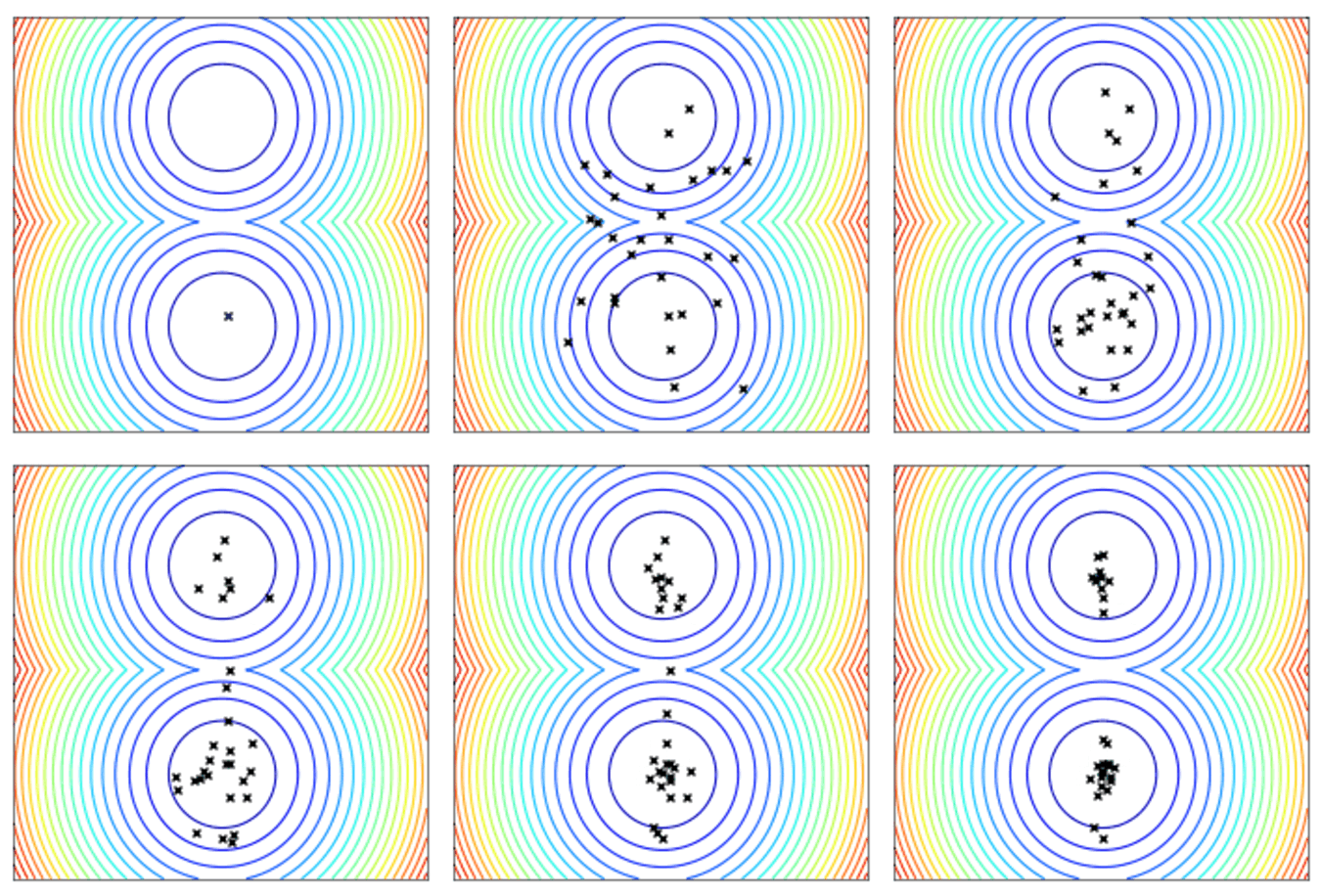
Convergence of a population of points to the minima with two-points DE.
Check out our documentation! It's still a work in progress, so don't hesitate to submit issues and/or pull requests (PRs) to update it and make it clearer! The last version of our data and the last version of our PDF report.
@misc{nevergrad,
    author = {J. Rapin and O. Teytaud},
    title = {{Nevergrad - A gradient-free optimization platform}},
    year = {2018},
    publisher = {GitHub},
    journal = {GitHub repository},
    howpublished = {\url{https://GitHub.com/FacebookResearch/Nevergrad}},
}
nevergrad is released under the MIT license. See LICENSE for additional details about it.
See also our Terms of Use and Privacy Policy.
FAQs
A Python toolbox for performing gradient-free optimization
We found that nevergrad demonstrated a healthy version release cadence and project activity because the last version was released less than a year ago. It has 3 open source maintainers collaborating on the project.
Did you know?

Socket for GitHub automatically highlights issues in each pull request and monitors the health of all your open source dependencies. Discover the contents of your packages and block harmful activity before you install or update your dependencies.
Product
Explore exportable charts for vulnerabilities, dependencies, and usage with Reports, Socket’s new extensible reporting framework.
Product
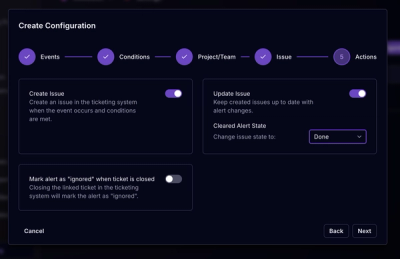
Socket for Jira lets teams turn alerts into Jira tickets with manual creation, automated ticketing rules, and two-way sync.
Company News
Socket won two 2026 Reppy Awards from RepVue, ranking in the top 5% of all sales orgs. AE Alexandra Lister shares what it's like to grow a sales career here.