

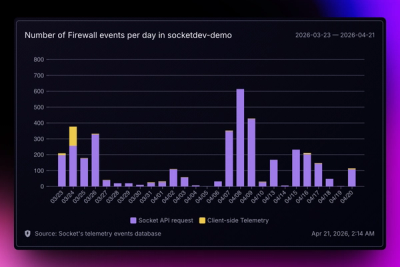
Product
Introducing Reports: An Extensible Reporting Framework for Socket Data
Explore exportable charts for vulnerabilities, dependencies, and usage with Reports, Socket’s new extensible reporting framework.
By André Staltz - Apr 21, 2026
github.com/fotiosbistas/retrieval-success-rate
Advanced tools
This repository aims to track the retrieval success rate of the provider records using the Optimistic Provide algorithm proposed by Dennis Trautwein, using Mikel Corte's repository IPFS CID HOARDER. The go-libp2p-kad-dht submodule uses the ProvidersFile branch for all the following workflow.
Example run:
go run retrieval_success_rate.go run_optimistic_provide --cid-number 4000 --log-level debug
//A container for the encapsulated struct.
//
//File containts a json array of provider records.
//[{ProviderRecord1},{ProviderRecord2},{ProviderRecord3}]
type ProviderRecords struct {
    EncapsulatedJSONProviderRecords []EncapsulatedJSONProviderRecord `json:"ProviderRecords"`
}

//This struct will be used to create,read and store the encapsulated data necessary for reading the
//provider records.
type EncapsulatedJSONProviderRecord struct {
    ID              string   `json:"PeerID"`
    CID             string   `json:"ContentID"`
    Creator         string   `json:"Creator"`
    PublicationTime string   `json:"PublicationTime"`
    ProvideTime     string   `json:"ProvideTime"`
    UserAgent       string   `json:"UserAgent"`
    Addresses       []string `json:"PeerMultiaddresses"`
}
If the sample size is small ( <= 1000 CIDs) the provider records are writen into a JSON file and inserted into the hoarder. The hoarder is then responsible for extracting the metadata from the JSON file, inserting the CIDs into the database and proceeding the ping them, gathering the necessary data to determine whether the Provider Records are retrievable.
If the cid-number is large (> 1000 CIDs) the HTTP server, inside the hoarder, is configured to listen to port:8080 and the hoarder's localhost address. The publisher, using for example the address http://localhost:8080/ connects to the server, and must use an HTTP POST method to send the CIDs to the server. The CIDs must follow the following format:
The HTTP server has an internal queue that contains an array of ``[]EncapsulatedJSONProviderRecord`` and using a ``GET`` request the hoarder can receive an element from the array.
```golang
type HttpCidSource struct {
    port            int
    hostname        string
    lock            sync.Mutex
    server          *http.Server
    providerRecords []ProviderRecords
    isStarted       bool
}
This means that the publisher must aggregate the EncapsulatedJSONProviderRecord for each CID into an array and then send it to the server. Then the same process as in the JSON file section is followed by the hoarder.
FAQs
Unknown package
Did you know?

Socket for GitHub automatically highlights issues in each pull request and monitors the health of all your open source dependencies. Discover the contents of your packages and block harmful activity before you install or update your dependencies.
Product
Explore exportable charts for vulnerabilities, dependencies, and usage with Reports, Socket’s new extensible reporting framework.
Product
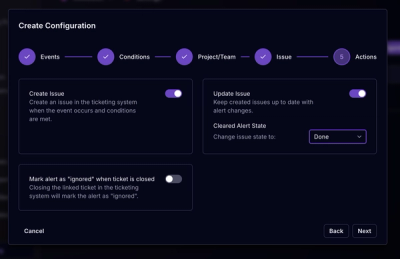
Socket for Jira lets teams turn alerts into Jira tickets with manual creation, automated ticketing rules, and two-way sync.
Company News
Socket won two 2026 Reppy Awards from RepVue, ranking in the top 5% of all sales orgs. AE Alexandra Lister shares what it's like to grow a sales career here.